


Why Cartagena’s golden hour is different—and where to watch it
There’s a moment, every single day, when Cartagena’s sky decides to catch fire. It lasts about twenty minutes. It feels like an hour. And if you’re in the wrong place, you’ll miss it entirely.
This isn’t an exaggeration. Cartagena’s sunset is genuinely, scientifically different. The combination of Caribbean humidity, equatorial latitude, and the city’s west-facing coastline creates a light show that photographers travel thousands of miles to capture.
But here’s what nobody tells you: where you watch it changes everything.
The physics of golden hour in Cartagena
At 10 degrees north of the equator, Cartagena experiences something unusual: the sun sets almost vertically. Instead of the long, drawn-out twilights you get in northern latitudes, you get intensity. The light doesn’t fade—it ignites.
The humidity acts like a filter, scattering light particles and turning ordinary oranges into deep magentas, pale yellows into liquid gold. On clear days, the sky cycles through more colors in twenty minutes than most cities see in a week.
And because Cartagena faces the Caribbean to the west, there’s nothing between you and the horizon. No islands. No mountains. Just water meeting sky in an unbroken line.
Where most people watch it (and why they’re wrong)
Café del Mar is the famous spot. Built into the old city walls, it offers direct ocean views and has become synonymous with Cartagena sunsets. On any given evening, you’ll find it packed with tourists, phones raised, competing for the perfect Instagram shot.
It’s fine. The view is real. But you’re watching the sunset with two hundred strangers, fighting for a table, and paying premium prices for watered-down cocktails.
The city walls offer a free alternative. You can walk along the ramparts, find a quiet spot, and watch the sky change. But you’re standing, it’s crowded during peak season, and vendors will interrupt your moment every few minutes.
Rooftop bars throughout the Old Town advertise sunset views, but most face the wrong direction, or have buildings blocking the horizon. You’ll see some color, reflected off clouds, but not the main event.
The case for watching from above
Here’s what changes when you’re elevated: perspective.
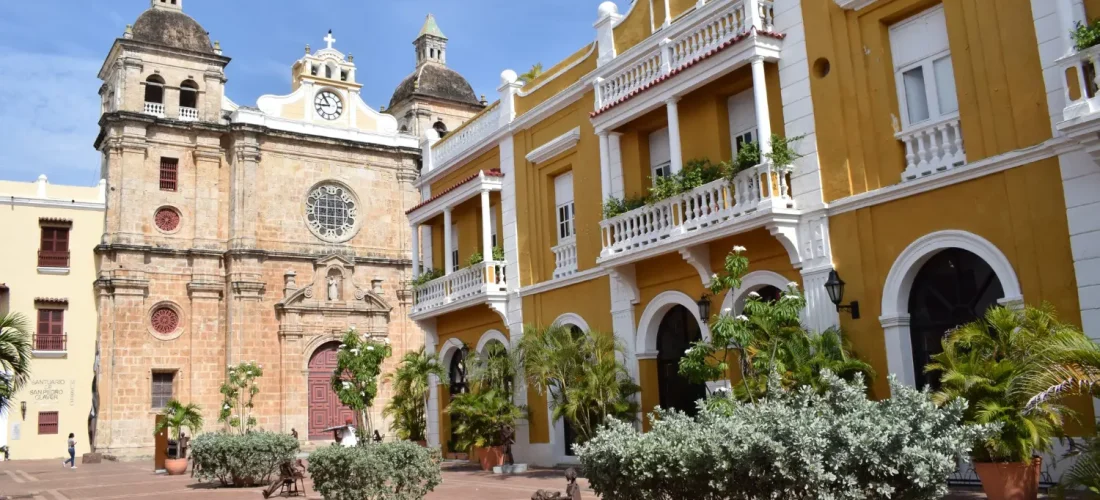
From street level, you see the sunset. From a high terrace, you see the sunset and the city transforming beneath it. The colonial rooftops shifting from white to gold. The church domes catching the last light. The bay turning from blue to bronze.
The highest points in the Old Town offer something else: uninterrupted sightlines. No heads bobbing in front of you. No waiters asking if you need anything. Just sky, sea, and twenty minutes of silence that actually feels earned.
Timing it right
Sunset in Cartagena happens between 5:45 PM and 6:15 PM year-round (the equator keeps things consistent). But the magic starts earlier and ends later.
- 5:00 PM: The light starts softening. Harsh midday shadows become gentle. This is when photographers start setting up.
- 5:30 PM: The golden hour begins properly. Everything looks better. Everyone looks better. This is when you should be in position.
- 5:50 PM: The sun touches the horizon. The countdown begins.
- 6:00 PM: Peak color. The sky is doing things that seem impossible. This lasts about ten minutes.
- 6:15 PM: The afterglow. The sun is gone but the sky is still pink, purple, fading to deep blue. Don’t leave yet.
- 6:30 PM: Stars begin appearing. The city lights come on. A different kind of beautiful.
What to bring, what to leave behind
Bring:
- A drink you actually want (not something you ordered because you felt obligated)
- Someone you don’t need to talk to (or comfortable solitude)
- A camera if you must, but know that no photo will capture it
Leave behind:
- The urge to document everything
- Conversation that requires concentration
- Your phone’s notifications
The locals have a phrase: “el sol se despide”—the sun says goodbye. They treat it as a small daily ritual, not a photo opportunity. There’s wisdom in that.
The truth about the “best” spot
Every travel guide will tell you where to watch the sunset. They’re all partially right and completely wrong.
The best spot is the one where you can actually be present. Where you’re not checking your phone, not fighting crowds, not worrying about your bill. Where twenty minutes feels like permission to stop.
Some people find that on the city walls. Some find it at Café del Mar despite the crowds. Some find it on a private terrace, drink in hand, watching the sky do what it does every single day—whether anyone’s watching or not.
The sunset doesn’t care where you are. But you might.